The Hidden Water Problem Inside Every House Fire
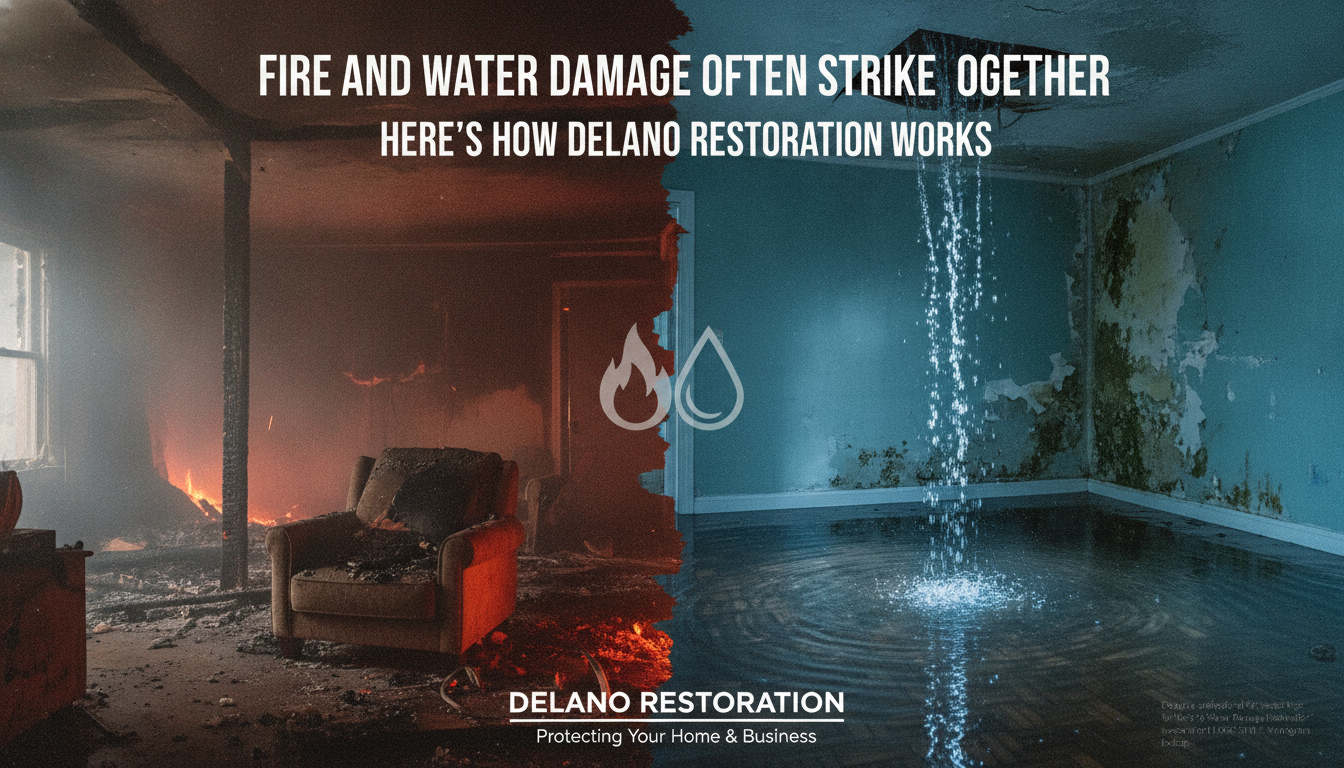
When people think about fire damage, they picture charred walls, burned belongings, and soot-covered ceilings. What rarely comes to mind is water — but fire suppression efforts by firefighters, sprinkler systems, and garden hoses can deposit thousands of gallons of water into a structure during and immediately after a fire event. That water saturates the same walls, floors, and structural assemblies that were weakened by heat, creating a compounding damage scenario that requires expertise in both fire and smoke restoration and professional water damage recovery.
For Delano homeowners navigating recovery after a fire, understanding how these two damage types interact — and why they must be addressed together in a unified restoration plan — can make the difference between a smooth recovery and a prolonged, expensive ordeal.
How Fire Suppression Water Differs From Other Water Intrusion
Water from firefighting efforts is not clean water. It picks up carbon, soot, ash, and chemical compounds from fire suppression agents as it flows through the structure, making it a Category 2 or even Category 3 contaminated water source under IICRC S500 standards. This matters because contaminated suppression water cannot simply be dried in place — surfaces and materials soaked by this water require decontamination protocols similar to those used in sewage cleanup situations, not standard clean-water drying procedures.
Additionally, suppression water enters structures in large volumes over a short time period and flows to the lowest accessible point — meaning basement areas, crawl spaces, and lower wall cavities often receive the heaviest saturation even if the fire itself was in an upper floor or kitchen area. Thermal imaging and moisture mapping are essential to find all of it.
The Phases of Combined Fire and Water Damage Restoration
Restoring a property after a fire is a multi-phase process. Delano Water Damage Restoration approaches every fire loss in a structured sequence designed to prevent secondary damage while making efficient progress toward full restoration:
Phase 1: Emergency Securing of the Structure
Before any interior restoration work begins, the structure must be made secure. Fire frequently compromises roof assemblies, windows, and exterior walls — leaving the interior exposed to weather and unauthorized entry. Emergency board-up of openings and temporary tarping of compromised roof sections is the first priority. This step also protects whatever unaffected contents remain inside from additional weather damage — a detail that matters significantly for insurance claim documentation.
Phase 2: Suppression Water Extraction and Structural Drying
With the structure secured, the water damage component of the loss must be addressed urgently. Suppression water that is allowed to sit while other restoration work is planned will deepen structural saturation, increase the risk of mold colonization, and weaken already fire-compromised framing. Our water damage restoration team deploys truck-mounted extractors and portable units to remove standing suppression water, followed by industrial air movers and dehumidifiers positioned using thermal imaging moisture maps to ensure every hidden pocket of moisture is addressed — not just the visible wet areas.
Moisture readings are logged throughout the drying period. This documentation is not only operationally important — it becomes part of the insurance claim record that supports your adjuster's damage assessment.
Phase 3: Soot Removal and Surface Cleaning
Soot is not inert residue. It continues reacting with surfaces for days and weeks after a fire, etching metals, discoloring fabrics, and permanently staining porous materials if not removed promptly. Different types of smoke leave different residues — dry smoke from fast-burning fires leaves a dry, powdery ash that brushes away relatively easily, while wet smoke from slow, smoldering fires leaves a sticky, pungent residue that requires chemical solvents and specialty cleaning agents. Protein smoke from kitchen fires leaves an almost invisible but intensely odorous film that is particularly difficult to remove from painted surfaces and cabinetry.
Delano Water Damage Restoration technicians are trained to identify each residue type and apply the appropriate cleaning approach. Using the wrong method on the wrong residue type can permanently drive contaminants deeper into surfaces — a costly mistake during fire and smoke damage restoration.
Phase 4: Odor Neutralization
Smoke odor is arguably the most persistent consequence of a fire loss. Smoke particles are extraordinarily fine and penetrate wall cavities, insulation, ductwork, wood framing, and soft furnishings — well beyond what any surface cleaning can reach. Eliminating smoke odor requires treatments that follow the same pathways the smoke itself traveled:
- Thermal fogging: A thermal fogger vaporizes deodorizing agents into particles fine enough to penetrate the same cavities and porous materials that absorbed smoke, neutralizing odor compounds at the source rather than masking them at the surface.
- Hydroxyl generation: Hydroxyl generators produce reactive molecules that break down odor-causing volatile organic compounds at the molecular level and are safe for use in occupied areas.
- HVAC duct cleaning: HVAC systems that cycled during or after a fire circulate smoke residue to every room each time they operate. Cleaning the duct system is a necessary step in comprehensive odor elimination.
- Ozone treatment: Ozone is a powerful oxidizer used in unoccupied spaces to neutralize embedded odor molecules in structural materials and contents — typically as a final treatment after surface cleaning and fogging are complete.
Phase 5: Reconstruction
After soot is removed, moisture levels have reached target readings, and odor treatment is complete, reconstruction of damaged areas can begin. This phase may involve drywall replacement, framing repairs, flooring installation, cabinetry replacement, and painting. The scope of reconstruction is determined by the documentation gathered in earlier phases — another reason why thorough moisture logging, photographic records, and written scope-of-loss reports are built into every step of Delano Water Damage Restoration's process.
Why a Single Restoration Provider for Both Fire and Water Damage Matters
When fire and water damage are handled by separate companies — one for fire and smoke, another for water extraction — coordination gaps almost always create delays, billing disputes, and overlooked damage. Drying timelines conflict with soot cleaning schedules. Moisture readings from one contractor are not shared with the other. Insurance documentation comes from two sources with inconsistent formats.
A unified provider eliminates these friction points. Delano Water Damage Restoration manages both the water damage restoration and fire and smoke damage restoration components of your loss under one coordinated plan, one point of contact, and one comprehensive insurance documentation package — simplifying your recovery at an already stressful time.
Watch for Mold After a Fire Loss
The warm, moist conditions created by suppression water in a fire-damaged structure are among the most favorable possible environments for rapid mold colonization. If structural drying is delayed — or if suppression water is not fully extracted — mold can establish colonies within 24 to 48 hours in materials that the fire itself did not destroy. This is especially relevant in Delano's warm climate, where ambient temperatures accelerate biological growth year-round.
Delano Water Damage Restoration integrates mold remediation monitoring into every fire loss project as standard practice — not an add-on — because the consequence of missing mold in a fire-damaged structure is a second remediation project on top of an already complex restoration.
Responding to Fire Damage in Delano and the Surrounding Area
Delano Water Damage Restoration provides fire and smoke damage restoration services throughout Delano and neighboring communities including McFarland, Famoso, Allensworth, and
Call +16616698320 or fill out our online form for a free, no-obligation quote.Confirm Availability